Just arrived in Sidney, Nebraska and spending the night at a hotel across the street from the World Wide Headquarters of CABELAS.
That aside, my charming husband and I drove 786 miles today - I'm going to fudge it and say 800 miles for simplicity.
Definitely glad I brought the bottle of Glenlivet single malt I always pack in the dogs' food bag. Since their bag gets unloaded from the car before everything else does, and since they're fed before anything else happens, I pour myself a respectable shot in the hotel's plastic cup, relax and watch the puppies eat as I sip and savor. A few moments of down time, relaxation and a bit of libation is just enough. Those few moments of quality time alone works wonders to keep me from saying all those really regrettable things that come to mind when we're tired, hungry, crabby and road-weary.
Note: Opportunities for relationship-testing abound!
I'd highly recommend that anyone contemplating marriage would be wise to drive cross country with his or her beloved accompanied by 2 very large farting dogs while also being prepared for blizzards, dust storms, pea-soup fog, black ice (never heard of that stuff before I began driving cross-country), in addition to migrating herds of elk, antelope (not to be confused with can't elope) the occasional stray cow who might wander onto the highway, and deer who engage in games of "chicken" with their fellow deer by darting in front of speeding vehicles. All these events generally occur during times of diminished visibility or extreme cold!
Sunday, February 17, 2013
Thursday, February 7, 2013
People In the Workshop I'm Conducting
During the last 3 weeks, I taught my memoir writing class – a workshop really, an introduction really, for local folks who’ve been thinking about writing in this genre for a long time but haven’t gotten going. It’s not for lack of interest. More likely, it’s from not knowing where or how to proceed. That said, it’s a tough go. I know. I, too, faced those dilemmas for an incredibly long time.The workshop title - Writing Your Life: Beyond Journaling. The people who attended - one by one, claimed they weren't writers
- But here is the misperception; a writer is someone who writes. Whether their writing is published, whether publishing is a goal or whether their writing is tucked away in a desk drawer to be savored privately - this doesn’t alter the definition of “writer.”
- The people in my workshop were an incredibly diverse and complex group. The people in myworkshop are passionate writers – each one approached the in-class writing exercises from uniqueperspectives and in highly creative ways. One gentleman drove two hours each way to attend. Heintrigued us with insights into rural life, reading aloud about horses, scriptures, and farming. All of thisso removed from my own urban life experiences. He arrived to our third and final meeting bearing agift: a huge jar of natural honey.
- There was the doctor and his wife who shared their common goal: to write their memoirtogether. But amazingly, they also wrote their own detailed pieces; he - about transporting childrenfrom overseas to the USA for specialized heart surgery; she - about her good fortune of having attendedcooking classes in Normandy.
- There was the man who could attend only on the first session but who came to learn whateverhe could in order to write about the search for his Polish roots. One woman, who hailed from NewYork to Idaho via thirty years in Los Angeles, wrote words that landed on paper as poetry. We sharedshort essays written in response to prompts. There were photos brought in, drawings of floor plansof childhood homes, and during our last meeting – scents contained within a group of containers thatranged from antiseptic cleaners to cinnamon and peanut butter.
- The people in my class may have learned about memoirs and prompts, about methods forapproaching the difficult task of organizing their memories and family documents, but I learned more. Iwas heartened by their willingness to read their written exercises, by their efforts to put into words theanswers to my challenging worksheets, and by the complex and well thought out questions they asked.
Tuesday, January 22, 2013
With Regard to Elk
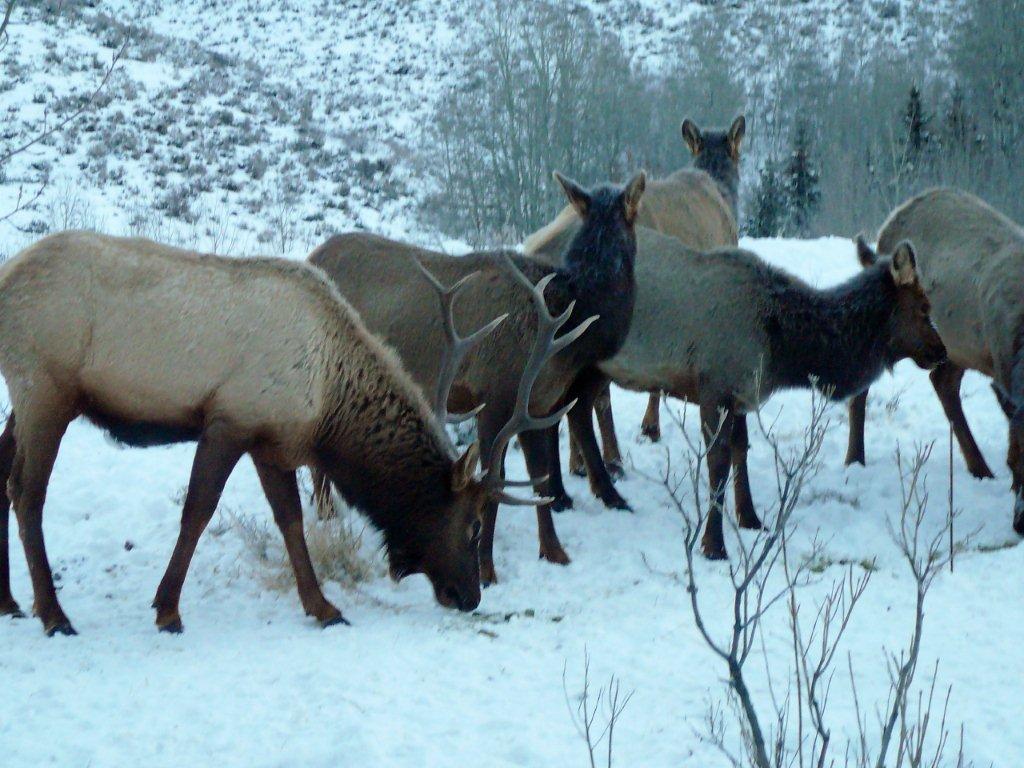
1. Their butts are not bald but very, very furry – in fact, a lovely shade of taupe fluff.
Sources suggest that it's evolutionary evidence that boy elks (who have really bad vision) need a great deal of help finding those sexy girl elks. The taupe butts must be elk language for, “it’s here, stupid!”
2. There’s a big mane of black fuzzy fur around their necks, more on the boys than the girls.
It’s similar to cashmere found on Cashmere goats and better at keeping the elk warm than an L.L.Bean polar fleece scarf.
3. We've had herds of elk down in the residential 'hoods surrounding Ketchum, Sun Valley and Hailey.Wolf populations in the Idaho Sawtooth Mountain Range have increased. This year, they’ve made their way south from Stanley, Idaho – higher elevations, towards Ketchum. The pack, referred to as the Phantom Hill wolves, has increased its numbers. It’s become obvious that all these seemingly unrelated events are very much part of a single chain. Elk, in response to increased wolf populations, arrived on local golf courses, in neighborhood gardens, and along the roads. What an amazing local wildlife
ecosystem to observe first hand!
So when elk traveled to the lower regions, mountain lions paid a visit to feast on elk. After filling up on elk steaks, elk burgers, and maybe a few chops, the lions retreated fairly satiated. But they’re not the neatest eaters and failed to clean up after themselves. No worries, however! Wolves arrived and tidied up a bit after the mountain lions. It’s a nice feast for wolves.
1. Glad to have two gigantic Rhodesian Ridgebacks, a.k.a. African lion dogs. Big bad lions beware!
2. Coming upon a male elk and his harem feasting on the vestiges of my garden, it was less than a
second before the male lifted his fully racked head in response to the click of my camera.
3. When a male elk lifts his antler-adorned head to look in my direction, retreating backwards into
my car or house is definitely a prudent idea!
4. A grown elk really is about the size of a Dodge Durango or Jeep Cherokee!
Elk Basics:
North American Elk, or Cervus elaphus, are split by some biologists into six subspecies:
• Rocky Mountain (Rocky Mountain West, now transplanted to other locations) – largest antlers of
all subspecies
• Roosevelt's (Coastal Pacific Northwest)
– largest in body size of all subspecies, but not antler size
• Tule (Central California) – smallest body size of all subspecies
• Manitoban (northern Great Plains)
• Merriam's (Southwest and Mexico) - Extinct
Eastern (east of the Mississippi) – Extinct
• Only male elk have antlers
• Bulls shed and grow a new set of antlers every year
• New antlers are covered in fuzzy skin called velvet
• Antlers harden by late summer and the velvet peels away
• By September, antlers are solid bone
• A set of antlers on a mature bull can weigh up to 40 pounds
Body Postures:
• When alarmed, elk raise their heads high, open eyes wide, move stiffly rotating their ears to listen.
• If a harem cow wanders, the bull stretches his neck low, tips his nose, tilts antlers back to circle her.
• Elk threaten each other by curling back their upper lip, grinding their teeth and hissing.
• Agitated elk hold their heads high, flatten ears back and flare nostrils, sometimes punch with their
front hooves
And the amazing thing is that elk talk. They’re known to be among the noisiest ungulates,
communicating danger loudly and identifying each other by sound. Their favorite times to
talk to one another seems to be sometime around 2:00-3:00 a.m. lately!
Monday, January 21, 2013
Where I'll Be!
LifeLines
A Story Circle LifeWriting Retreat
with Sheila Bender
March 8-10, 2013
Festival Hill, Round Top TX
"Located in historic Round Top, Texas, 75 miles east of Austin, The International Festival-Institute was founded in 1972 by world-renowned concert pianist James Dick and has developed incredible year-round education and performance programs. It's on a unique 200-acre campus named Festival Hill with performance facilities, historic houses, incredible gardens, parks and nature preserves. In addition, housed on the campus are rare books, manuscripts, archival material, music and historic recordings, photographs and objects. The Festival-Institute is regarded as a center for research and scholarly study. Landscaping is breath-taking regardless of the time of year. There are thousands of trees and bushes of various species, lakes, picnic areas, jogging trails, and aromatic herb gardens. "
Tuesday, January 8, 2013
The AROHO Retreat in August is on!
Hooray! I'll be attending the AROHO Retreat at Ghost Ranch in New Mexico again in August. What a great bit of news to be accepted. Amazing organization, incredible women, a life-changing week! www.aroomofherown.org
Why Write Your Memoir? Why Take My Workshop?
On Friday, I was honored to be the guest speaker at the Wood River Jewish Community annual women’s luncheon in Ketchum, Idaho. The primary focus of my presentation: to promote the workshop I’ll be leading in January entitled, “Writing Your Life: Beyond Journaling.” The workshop will meet three times for two and a half hours each session. Enthusiasm seemed high but a subdued level of reluctance was in the air!
There are an unlimited number of reasons to write our memoirs. I've organized my workshops for anyone and everyone who has motivation and interest - for writers who've written volumes to those who have written little else besides checks and to those who write in journals regularly or rarely.
So often people express enthusiasm and interest, curiosity about and an intense desire in writing their memoirs yet, at the same time when given the opportunity, become reluctant to participate in a workshop. Regardless of how old we are - how self-confident and accomplished, there’s still that element of worry that lingers from childhood, too much concern about what others might think of our writing, of our stories, or even whether our stories merit writing about.
So all up, reluctance to write our “truths” isn’t really about being shy or inexperienced but about an overwhelming concern of how our writing and stories might measure up. So many “wanna-be” memoir writers make the same comment to me, “But I haven’t done anything special, nothing traumatic has happened to me. No one would care about my stories. “
In my effort to convince a roomful of women to sign up for my memoir writing workshop, I assembled a list of ten very persuasive reasons why everyone should write memoirs. One qualifier: memoirs are not necessarily written only with publication as our goal.
10 REASONS TO WRITE YOUR MEMOIR:
1. Writing your memoir helps you discover who you are and how you got to your present place in life.
2. When you write about your life, others learn life lessons from reading your work.
3. Writing about your life increases your self-esteem because the process of remembering long-forgotten events enables you to share with your siblings, your children and grandchildren.
4. Writing your own “truth” not anyone else’s is entirely about perceptions – yours, and consequently can be very liberating.
5. Writing your memoir provides you with the means to save your memories, can result in added insight and offers a vehicle by which to share your memories.
6. The process of writing about your life increases brain activity as you search your memories. The process of trying to remember specifics stimulates brain activity which helps grow neurons.
7. Journaling and life-writing has proven to be therapeutic and healing; it helps resolve dilemmas, focus your goals and vision and can lead you to recreate yourself.
8. Writing enhances creativity but writing about your life encourages you to become a better observer of your family and of your surroundings.
9. Writing your memoir provides a great sense of accomplishment.
10. Your memoir – regardless of its style, is your legacy, your kids’ and grand-kids legacies, and provides a connecting thread between our pasts and futures.
But more than anything - our stories make us human because our stories have universality.
Einstein is credited with once having said,
There are an unlimited number of reasons to write our memoirs. I've organized my workshops for anyone and everyone who has motivation and interest - for writers who've written volumes to those who have written little else besides checks and to those who write in journals regularly or rarely.
So often people express enthusiasm and interest, curiosity about and an intense desire in writing their memoirs yet, at the same time when given the opportunity, become reluctant to participate in a workshop. Regardless of how old we are - how self-confident and accomplished, there’s still that element of worry that lingers from childhood, too much concern about what others might think of our writing, of our stories, or even whether our stories merit writing about.
So all up, reluctance to write our “truths” isn’t really about being shy or inexperienced but about an overwhelming concern of how our writing and stories might measure up. So many “wanna-be” memoir writers make the same comment to me, “But I haven’t done anything special, nothing traumatic has happened to me. No one would care about my stories. “
In my effort to convince a roomful of women to sign up for my memoir writing workshop, I assembled a list of ten very persuasive reasons why everyone should write memoirs. One qualifier: memoirs are not necessarily written only with publication as our goal.
10 REASONS TO WRITE YOUR MEMOIR:
(Yes, I presented 10 but the reasons are in the hundreds!)
1. Writing your memoir helps you discover who you are and how you got to your present place in life.
2. When you write about your life, others learn life lessons from reading your work.
3. Writing about your life increases your self-esteem because the process of remembering long-forgotten events enables you to share with your siblings, your children and grandchildren.
4. Writing your own “truth” not anyone else’s is entirely about perceptions – yours, and consequently can be very liberating.
5. Writing your memoir provides you with the means to save your memories, can result in added insight and offers a vehicle by which to share your memories.
6. The process of writing about your life increases brain activity as you search your memories. The process of trying to remember specifics stimulates brain activity which helps grow neurons.
7. Journaling and life-writing has proven to be therapeutic and healing; it helps resolve dilemmas, focus your goals and vision and can lead you to recreate yourself.
8. Writing enhances creativity but writing about your life encourages you to become a better observer of your family and of your surroundings.
9. Writing your memoir provides a great sense of accomplishment.
10. Your memoir – regardless of its style, is your legacy, your kids’ and grand-kids legacies, and provides a connecting thread between our pasts and futures.
But more than anything - our stories make us human because our stories have universality.
Einstein is credited with once having said,
“ The universe is made not of atoms but of stories!”
Friday, December 21, 2012
Year End Gratitude Thoughts From Ketchum, Idaho
Last week I drove from Chicago, Illinois – where I live, across a big chunk of America so many of us never, ever see. My destination -Sun Valley, Idaho where I’ll be spending the holidays, teaching three memoir writing workshops, and editing my short story collection. All this will occur while I’m enjoying the amazingly pristine scenery and winter snow of the American Northern Rocky Mountains. Arriving after the 1,746 miles in two and a half days with my two gigantic dogs, I was crabby and exhausted.
It was at that moment when I decided to leave my unpacking and instead, to take a long walk in newly fallen snow. I watched my dogs bound through powdery drifts for the sheer fun of it, chase each other, burrow their heads deep into tunnels and emerge covered in crystals. Suddenly, I realized that I was smiling, realized that my mood had lifted tremendously and realized, especially, how incredibly grateful I am to have such tremendous opportunities!
Sunday, December 2, 2012
What Does Ohau Have to Do With Proust?
Sometimes small details and little touches, harness incredible powers - transforming "simple" into "simply elegant." A good dose of good luck landed me in Honolulu this week for an entire week. What greeted me as I opened my hotel room door was a beautiful and exceedingly welcomed late afternoon treat; papaya with lemon wedges that proved sweeter than any I've ever enjoyed on the mainland.
(Blogger's observation: do not to say "in the U.S.A" but rather remember the word mainland, lest you come across as a total moron!)
I couldn't help but wonder if, in fact, this papaya really was much sweeter than those I usually eat at home in Chicago or whether my perception of flavor was the result of an interplay between my sense of vision and my sense of taste. Besides, I arrived ravenous. It was too late for lunch, too early for dinner, and my body clock knew it was four hours beyond the local time.
Like most things in my life, I immediately related my quandary to a book I'd read - one in which the author addressed these dilemmas head on; the influence of our senses upon one another, all tied up in our perceptions. And hence - what I remembered was the interplay between vision and the taste of food as we've perceived it.
And that book? Proust Was a Neuroscientist, a non-fiction book by Jonah Lehrer published in 2007.
In this book, Lehrer contends that Proust, along with most of his fellow artists, discovered things about the brain that took Neuro-scientists decades to understand. There is an inter-connectedness between art and science but there's also a crucial impact visual presentation has upon our other senses. My favorite discussion pertains to how important detail is in the way a chef plates his or her culinary creation. We learn much about the visual display's influence upon the diner 's enjoyment of the food's taste and smell.
Lehrer also presents profiles of eight artists - most of whom are writers but also include a chef, painter and composer. The author argues that often these creative individuals understand vastly more about our perceptions than do neuro-scientists. The primary observation: truth can begin with "what reality feels like." I suppose that might also be "what reality tastes like"!
So, even though the book examines the importance of art and the role that vision has in human perceptions including sensory stimuli such as taste and smell, Lehrer also addresses art and artists. The wonderful quality of this book is that it reminds us how complex and subjective our perceptions really are.
I consider Lehrer's peak essay to be his piece about Auguste Escoffier, the chef credited with inventing modern French cookery. Lehrer's personal interest in food preparation leads to his research about the invention of MSG ( monosodium glutamate) and umami - the amino acids that play with our taste buds. In this way, science influences perceptions about taste.
The author's background includes lab work, science writing and fine cuisine. He's discussed Cézanne's breakthroughs in understanding human sight, Walt Whitman's comments about how biology influences our thoughts and- the impetus for the book, Proust's efforts to tap into his memory by immersing himself in childhood recollections.
As recently as five years ago, The Wall Street Journal challenged conventional culinary science with its story entitled: A New Taste Sensation- Parmesan cheese has it. So does ketchup.
It's umami, and it's changing the way everyone from top chefs to Frito-Lay executives thinks about food. WEEKEND JOURNAL December 8, 2007 reported about the mysterious (at least in the USA) role umami plays in our perceptions of taste.
"Americans are taught from an early age that there are four basic tastes -- sweet, salty, sour and bitter. But what describes the taste of chicken soup?"
An ever increasing number of professional chefs and food-industry experts have begun to refer to "umami," as "the fifth taste."
Lehrer tells us that umami was first identified by a Japanese scientist more than century ago but it remained a very obscure culinary concept. The reason? it's tough to describe and to define although it's commonly discusses as a meaty, savory and very satisfying taste.
And so that all came back to me in the multi-sensory encounter with a papaya! Think about what you'll be tasting after you've given your food a good stare-down.
(Blogger's observation: do not to say "in the U.S.A" but rather remember the word mainland, lest you come across as a total moron!)
I couldn't help but wonder if, in fact, this papaya really was much sweeter than those I usually eat at home in Chicago or whether my perception of flavor was the result of an interplay between my sense of vision and my sense of taste. Besides, I arrived ravenous. It was too late for lunch, too early for dinner, and my body clock knew it was four hours beyond the local time.
Like most things in my life, I immediately related my quandary to a book I'd read - one in which the author addressed these dilemmas head on; the influence of our senses upon one another, all tied up in our perceptions. And hence - what I remembered was the interplay between vision and the taste of food as we've perceived it.
And that book? Proust Was a Neuroscientist, a non-fiction book by Jonah Lehrer published in 2007.
In this book, Lehrer contends that Proust, along with most of his fellow artists, discovered things about the brain that took Neuro-scientists decades to understand. There is an inter-connectedness between art and science but there's also a crucial impact visual presentation has upon our other senses. My favorite discussion pertains to how important detail is in the way a chef plates his or her culinary creation. We learn much about the visual display's influence upon the diner 's enjoyment of the food's taste and smell.
Lehrer also presents profiles of eight artists - most of whom are writers but also include a chef, painter and composer. The author argues that often these creative individuals understand vastly more about our perceptions than do neuro-scientists. The primary observation: truth can begin with "what reality feels like." I suppose that might also be "what reality tastes like"!
So, even though the book examines the importance of art and the role that vision has in human perceptions including sensory stimuli such as taste and smell, Lehrer also addresses art and artists. The wonderful quality of this book is that it reminds us how complex and subjective our perceptions really are.
I consider Lehrer's peak essay to be his piece about Auguste Escoffier, the chef credited with inventing modern French cookery. Lehrer's personal interest in food preparation leads to his research about the invention of MSG ( monosodium glutamate) and umami - the amino acids that play with our taste buds. In this way, science influences perceptions about taste.
The author's background includes lab work, science writing and fine cuisine. He's discussed Cézanne's breakthroughs in understanding human sight, Walt Whitman's comments about how biology influences our thoughts and- the impetus for the book, Proust's efforts to tap into his memory by immersing himself in childhood recollections.
As recently as five years ago, The Wall Street Journal challenged conventional culinary science with its story entitled: A New Taste Sensation- Parmesan cheese has it. So does ketchup.
It's umami, and it's changing the way everyone from top chefs to Frito-Lay executives thinks about food. WEEKEND JOURNAL December 8, 2007 reported about the mysterious (at least in the USA) role umami plays in our perceptions of taste.
"Americans are taught from an early age that there are four basic tastes -- sweet, salty, sour and bitter. But what describes the taste of chicken soup?"
An ever increasing number of professional chefs and food-industry experts have begun to refer to "umami," as "the fifth taste."
Lehrer tells us that umami was first identified by a Japanese scientist more than century ago but it remained a very obscure culinary concept. The reason? it's tough to describe and to define although it's commonly discusses as a meaty, savory and very satisfying taste.
And so that all came back to me in the multi-sensory encounter with a papaya! Think about what you'll be tasting after you've given your food a good stare-down.
Friday, November 16, 2012
INTRODUCTION TO MEMOIR WRITING & MORE
January 16th, 23rd, & 30th
Have you wondered about what exactly "memoir" is? What's the difference between memoir and memoirs, autobiography and biography? Why write one and just how or where do you begin? Who would care?
There are many reasons to write your memoir but don't confuse "memoir" with non-thematic "memoirs", those disjointed reminiscences most commonly written by celebrities. Also, memoir shouldn't be confused with autobiography.
Everyone has stories - unique ones and ordinary ones. Some are amazing and inspiring, others funny or sad. But one thing is certain; we all have lots and lots of them. Many of our life-stories fall into themes but not knowing how to select those themes is a major roadblock to beginning a memoir. Mostly, we're overwhelmed!
If you've considered writing your own memoir, this workshop is for you. Whether you're a complete novice or a seasoned writer, I'll teach you how to use "prompts" to help engage your writer's memory. Regardless of your intentions - self-publishing 20 copies to share with your family or in hopes of future publication and sale, we'll learn how to focus our stories while also having fun.
We'll meet for 2 1/2 hours for three consecutive weeks. And given the use of "threes," the memoir-writing workshop consists of 3 components to help us along;
1. Instructional exercises, worksheets and discussion
2. short readings - to be handed out in class
3. Group writing assignments and sharing our work
What you'll need to bring:
1. Your writing journal if you keep one
2. One-two personal photographs
3. Your enthusiasm and positive attitude
Hope to see you there!
Wednesday, November 14, 2012
Spelling, Grammar, and Remembering Homophones
| A pair of pears, get it? |
Are they the result of sloppy proofreading or something more profound? Proofreading is mysterious and elusive! Proofreading and then proofreading already proofread work tends to reveal an error here and there that we were certain we fixed. I'm no exception. Typos happen to everyone - the unavoidable function of typing quickly in our efforts to keep up with thoughts moving forward much too quickly for our fingers to keep pace.
In all honesty, it's not as though I'm exempt from typographical errors or spelling mistakes but there are several tricks that, while old-fashioned and very low tech, remain tried and true.
First: I reread all my work aloud, even writing I'm positive I've already proofread and already corrected.
Second: I actually print out my work. I've yet to understand it but transitioning from a screen to ink on paper often reveals something I missed before - sometimes simply an extra space or superfluous comma, but they do appear easier to spot.
Last: Once printed, I walk away for a while - ideally, a day or two but not always. Coming back for a second, and even third, view can yield a few more surprises.
Even with all those precautions, I've had the horrifying experience of reading an essay I've published or something I've posted online only to discover a glaring mistake gone public! For some mysterious reason, it totally evaded detection.
The event that inspired my current rant: four emails I received this morning from writers' blogs, writing journals and community boards for writers. Of those four, three had blatant errors. The particular errors that seem incredible are grammatical or word usage ones made by those who consider themselves to be professional writers.
Number I - from a community blog for food writers as follows:
"If your a food blogger or writer..."
My guess is that the intended word is "you're," the contracted form of "you are."
Number II - an email from an organization that supports writers stating:
"You should of received your first newsletter ..."
The correct statement, "you should have..." should have been mastered by third or fourth grade.
Number III - a set of guidelines for posting from an online community for women writers I joined recently. Etiquette rules are a primary concern as the email noted:
"We have a no-all-caps policy. We want to remain a polite, positive group and if a few people are aloud to shout, it spoils it for us all!"
And that noted, shouting aloud may work in a sentence but wouldn't it make more sense for writers to request that participants not be allowed to shout? Hopefully, this was just an example of "clumping theory" that seems more common in probability studies.
Subscribe to:
Posts (Atom)