I'm Pleased To Announce that my essay, “Why Do I Cook?” was just accepted for publication by True Words Anthology, December 2012
The True Words Anthology is an annual members-only newsletter, published each Spring, and made up of stories and poetry to showcase the wonderful writing of the members of Circle Story Network
Details Coming Soon.
Friday, November 2, 2012
Friday, October 26, 2012
Before Darkness Settles
Fall is definitely here with her earthy smells of damp leaves, wet soil, and depending upon where I am - routes walked or roads traveled, the increasingly crisp morning winds may be redolent of pine or of ocean scents mimicked by Lake Michigan.
I love fall in a melancholy sort of way. It's an ambivalence really, one full of nostalgia for those autumns of my childhood. Becoming aware of fall's earthiness also is to become keenly aware of other scents now absent. Like youth, they're grounded in another life.
Maybe somewhere in America - in her suburbs and rural communities, in urban residential neighborhoods, leaves are still raked into huge piles. In those places, maybe children continue to jump into those piles, and parents continue to nag their children to help with the raking? It's a task not unlike tormented Sisyphus's. Poor pathetic Sisyphus who continuously pushed a boulder upward, and that boulder continuously rolled back upon him.
But is there anywhere in America where piles of leaves are still being burned, still filling nostrils with a smoke- laden dampness? Oddly, it wasn't entirely an unpleasant scent. I don't really know except that today, staring at leaf patterns on my walkway, then lifting my head to absorb ambient fall aromas, I realized that scent of burning leaves most likely is gone forever.
Today, I'm reminded to enjoy the few remaining days before taking my dogs outside will require pulling on boots, hats, parkas, gloves and more; to enjoy the few remaining days before darkness settles on my neighborhood at 5:00 p.m. and Thanksgiving is on the horizon while spring seems years away!
Saturday, October 20, 2012
GOOD NEWS! I've become an Amazon Reviewer.
Approaching the commercial arena:
You can read my Reviews at Amazon.com
I'm always on the lookout for wonderfully written books and articles about food and travel, another heavy-on-food genre as well as books about writing, research methods and the usual heart wrenching narrative. But let's keep in mind one critical fact - we can't eat scenery and really do tend to remember those wonderful meals enjoyed away from home. Consequently, I'm usually a bit hyper critical of food writing but this collection definitely makes the grade and hit the spot for me.
You can read my Reviews at Amazon.com
Monday, October 1, 2012
Research Time and Place: Salmon River
I've always been intrigued by research - the process, the investigative challenges, and of course the results. Any writing that contains even the slightest reference to a time and place -whether fiction or non-fiction demands validation of facts.
When the writer describes a scene, presents dialogue or refers to an event, the past about which he or she is writing is really occurring the "NOW..." for the characters - individuals who created the public records. Historians may live in the present while looking back into the past but writers have an under-appreciated yet just as important of a responsibility: to place the reader into the context of by-gone events and eras. In doing so, the writer brings characters forward into the present for the reader.
Accuracy allows readers to experience the kinds of emotions with which the characters are dealing - their hopes, conflicts, pain, and resolution but presented accurately so readers will internalize those feelings as though actually living in the time period being written about.
One of my favorite books - one that brilliantly deals with numerous difficulties and concepts of historical research is The Art and Craft of Writing Historical Fiction by James Alexander Thom. That noted, clearly the same strategies and rules are followed by writers of nonfiction, too!
Thom details methods for:
*Finding and using historical archives
*Conducting real-life field research
*Reconstructing a milieu about which you're writing- people, voices, cultural contexts & physical environments
*Achieving verisimilitude - the appearance of the true, in speech, action, and setting
I strive, in my writing, to focus upon verifying all information I've gathered that might end up in my stories or essays. To me, it's clear that if I plan to weave historical fact with a compelling plot then accurate descriptions comprise the foundation of my stories' believability.
Several days ago, I was drafting an essay about the first two or three times I ever visited Idaho. Those trips included drives across the Galena Summit and down through the Stanley Basin. Last week I took the same drive. It was twenty years later and when I arrived at an historical scenic overlook, a turnout really on Rt. 75, the road market indicated we were at an elevation of about 8000 ft. The highest peak in the area is 11153!
I was describing rivers. I was checking a map and listing names of those I could see from the overlook. But I was most intrigued by the names of several rivers noted in large italicized fonts on my topographical maps. there is the Big Lost River; another lists the Frank Church River of No Return Wilderness. My reference sources claimed that it is the largest wilderness area in the contiguous United States.
I stopped to take photos. When I read the sign post at the overlook, the graphics and text imbued a drama feel to the sign post when considered within its historical context.
When the writer describes a scene, presents dialogue or refers to an event, the past about which he or she is writing is really occurring the "NOW..." for the characters - individuals who created the public records. Historians may live in the present while looking back into the past but writers have an under-appreciated yet just as important of a responsibility: to place the reader into the context of by-gone events and eras. In doing so, the writer brings characters forward into the present for the reader.
Accuracy allows readers to experience the kinds of emotions with which the characters are dealing - their hopes, conflicts, pain, and resolution but presented accurately so readers will internalize those feelings as though actually living in the time period being written about.
One of my favorite books - one that brilliantly deals with numerous difficulties and concepts of historical research is The Art and Craft of Writing Historical Fiction by James Alexander Thom. That noted, clearly the same strategies and rules are followed by writers of nonfiction, too!
Thom details methods for:
*Finding and using historical archives
*Conducting real-life field research
*Reconstructing a milieu about which you're writing- people, voices, cultural contexts & physical environments
*Achieving verisimilitude - the appearance of the true, in speech, action, and setting
I strive, in my writing, to focus upon verifying all information I've gathered that might end up in my stories or essays. To me, it's clear that if I plan to weave historical fact with a compelling plot then accurate descriptions comprise the foundation of my stories' believability.
Several days ago, I was drafting an essay about the first two or three times I ever visited Idaho. Those trips included drives across the Galena Summit and down through the Stanley Basin. Last week I took the same drive. It was twenty years later and when I arrived at an historical scenic overlook, a turnout really on Rt. 75, the road market indicated we were at an elevation of about 8000 ft. The highest peak in the area is 11153!
I was describing rivers. I was checking a map and listing names of those I could see from the overlook. But I was most intrigued by the names of several rivers noted in large italicized fonts on my topographical maps. there is the Big Lost River; another lists the Frank Church River of No Return Wilderness. My reference sources claimed that it is the largest wilderness area in the contiguous United States.
I stopped to take photos. When I read the sign post at the overlook, the graphics and text imbued a drama feel to the sign post when considered within its historical context.
Thursday, September 27, 2012
New Feature: Where I am Now
Fall has
arrived and so have the last of the homegrown tomatoes we’ve nurtured all
summer. Where I am this week– approximately
7000 ft. altitude in the Northern Rocky Mountains, summers are short-lived,
very short as in 6 – 8 weeks. This translates to very short growing seasons.
If you reside anywhere in the Northern
hemisphere, fall officially began at 10:49 a.m. EDT. Also known as the autumnal equinox (equinox is Latin for "equal night"), it’s one of the two equinoxes in which the Sun crosses the celestial equator so,
as a result, the number
of night hours and day hours are equal.
So what does this
have to do with tomatoes? Simple – as the growing season shuts down in cooler
agricultural zones, grab the last of your harvest before frost does. Besides,
the threat of frost – already a nightly event here at higher elevations, the
decreased daylight hours means your edible bounty probably won’t ripen much
more outside.
My solution:
Create a “mini-greenhouse” of sorts using 2 clear glass baking pans to
nudge along any potential ripening. I placed mine on the kitchen counter moving
it, mid-day, to a coffee table near a sunny window. I rotate the tomatoes a bit for an even “suntan.” But that
noted, smaller green tomatoes may not ripen at all. Those are the ones I’ve
committed to the pickling jar and the soup pot. My mini-greenhouse solution works well for green-peppers that
will morph into red after being exposed to extra sunlight. Enjoy your crop and future pickles!
Monday, September 24, 2012
Just What Is a Curveball?
Google.com:
As in baseball,
people talk about a curve ball in real life. Usually, they’re referring to
situations in which they’ve guessed incorrectly about upcoming events or in
which they may have been fooled by a clever opponent. For instance, a company
may have priced their products based upon their competitors’ current prices
only to discover that the other company had a new, less expensive product being
developed. That could be regarded, by the first company, as a “curve ball” from
a strategic perspective. The term suggests an element of being caught
unprepared or prepared for the wrong kind of event.
Today is a curveball day –
the kind of day on which I must contemplate an interesting, age-old
philosophical question: If I knew
the day on which I’d take my last breath, the one that was to be my last on
earth, would I do something special? What, if anything, would I do differently?
With whom would I spend that last day and where?
I’ve read volumes and
volumes about writing techniques: where and how to find writing prompts, how
important it is to write regularly – that magic 1000 words a day every day.
It’s an activity both serious and worthwhile – the practice of making a regular
date with ourselves to write, the importance of keeping that date just as we‘d schedule
a lunch with a friend or a meeting with a colleague and would never consider canceling.
One writer’s manual I consult regularly even advises, “Write as though it was
your last day on earth.”
And so, today is what I’ve
come to refer to as “a curveball day,” one on which I challenge the conventional
wisdom delivered to writers by writers.
So really, if today was my very last day on earth, honestly - would I spend any part of it
writing? Probably not!
Today I’ve
accomplished nothing tangible or at least, nothing that looks productive. When
life throws me a “curve ball,” I must summon every ounce of stored knowledge
about what it means to be a compassionate friend - supportive when I myself
have a tremendous need to be both understood and supported.
A long-time friend (let’s call
her Marsha) who’s ten years older than I, phoned me this morning to relay shocking
news. Her husband of 35 years just died. The “just” is as in “just,” – like a
few hours ago.” He didn’t fade away. He didn’t suffer. He wasn’t ill or elderly,
and surely wasn’t taken from planet Earth in an accident. Nope, not at all! Literally
he simply just died, dropped right there in his tracks, just stopped. Most
likely his were hiking tracks, a trail in the wilderness area. My friends live in
the mountains of Idaho and after a full day of hiking, a day filled with sunshine
and majestic scenery, Robert packed their day packs and hiking poles in through
the SUV’s hatch. “My feet hurt.” Robert said
followed by a thud. And, that was it. He was gone as in dead.
Well traveled, vigorous
and adventuresome, these two friends had braved remote regions of Rwanda where
they observed gorillas; the Yukon Territory of Canada where they made camp among
the disappearing polar bears, and to Patagonia to live among gauchos crossing
mountains by day on horseback along terrifying ridges and staggering terrain. When
Marsha described their approaching challenging trips, I pondered the inherent
dangers. It wasn’t out of the question that Marsha and Robert were risking bear
mauling, possible murder by rebels, or death resulting from a fall off horseback
as in a tumble over rocky cliffs? Why at their ages, I wondered, do they pursue
such craziness – the stuff I would have considered only when I was in my 20’s?
Today I’ll obsess about
life’s tenuous nature as I will tomorrow and the day after and many days after
that. Today, I’ll consider the extent to which we take for granted that we’ll
be here next week, next month, tomorrow! We’ll take care of ourselves beginning on Monday, beginning
next week or on our birthdays. Today we’re too busy. We’ll call that close friend of ours who lives overseas, the
one we’ve been neglecting for months. We’ll hug our spouses, our children (grandchildren
if we have any) and our parents if they’re still alive.
Tonight my husband and I are going to a movie. It’s one we’ve been
meaning to see for quite some time. If our friend had known today was to be his
last day on earth, I have to believe that he wouldn’t have chosen to spend it
any other way!
Thursday, September 13, 2012
Why Do I Cook?
My mother’s culinary creations evolved in concert with the progression of her life.
She never owned a cookbook. She carried nothing tangible forward from the destruction
of her past into her life in the present. In many ways, the obliteration wrought by the
Holocaust she survived deleted my history as well. Foods she cooked were grounded
in her recollections of life in Romania before World War II, not in recipes scribbled on
yellowing or stained note-cards handed down from grandmother to mother to daughter
or from aunts to nieces and beyond.
When I’m in my kitchen, I reminisce about the meals entirely unique to my
mother – ones my brother and I still challenge each other to reproduce. My mother’s
cooking spanned the range of our economic status - poverty to plenty and all that lies
between. Those memories weave the responses I proffer to friends and strangers alike,
who ask, “Why do you cook?” or “Who taught you to cook?”
I cook a great deal, blog about cooking, watch shows about cooking when
the world news is replete with tales of destruction.
I write articles about cooking that
occasionally are published. I’ve even taught cooking!
Can I answer these seemingly straight-forward questions but not ruminate
about women passing their recipes and cooking secrets on to their progeny? At
times I’m compelled to ask: who did teach my mother to cook? My mother – the smart
young woman from an Orthodox Jewish family growing up in a remote Romanian
village; my rebellious mother who pursued education in lieu of culinary skills during
the era, historically, when Jewish girls married young and rarely ventured beyond their
garden gates.
My mother couldn’t learn from her mother - one of millions of mothers
and “would-be” mothers killed in places bearing names like Dachau or Auschwitz or
Ravensbruck.
So what is my answer? It’s not one but a complex web of answers!
I cook to create what reminds me of the scent of home and the security of family.
I cook because cooking distracts me from life’s problems as I become absorbed by the
ingredients’ sensory elements.
I cook because going to a restaurant when I’m tired or
harried does the chef a disservice and deprives my taste buds of due appreciation. I
cook because it’s the consummate way I can show family and guests that I care about
them - a hug around our most basic senses and with the power to unite strangers.
Cooking, tasting and memory become inseparable.
I cook to celebrate spring’s intense colors; newly ripened berries, crisp baby
greens, and delicate young vegetables picked before they’ve grown large and tough.
I cook as an adieu to vestiges of summer, to welcome fall’s heartiness with pumpkins,
apples, peaches and squash.
I’ll reconfigure fall’s bounty into spreads and soups and
pies. They’ll become the flavors of summer that live on in my kitchen to help brace me
for winter ahead, a winter of short days and cold, early evenings.
I cook to boost my self-esteem of which a part depends upon being better at one
thing than anyone else in my family is - a family comprised of men who know everything
about most things yet vastly less about cooking than I do. I cook as my avenue to
creativity like the many short stories I write and books I savor.
I cook to progress in life.
Cooking is progressive. And, as I progress, I know that all those meals I’ve cooked over
the years will help my sons remember me when they’re far away or I’m no longer here.
I cook to invent and to be creative. Then, I reinvent, edit and test again - exactly
as I reinvent myself each morning and with each edit of my stories. I cook as a way to challenge myself to grow, to travel the world, and to befriend it by meeting the foods and flavors of unfamiliar lands and cultures. And when I do, I inhale their scents, touch the delicate and coarse and if ever the opportunity to visit arrives – well, then their familiarity will welcome me in like a friend inviting me to a meal.
I cook because it provides an exceptional avenue into understanding others – observing what they will or won’t eat, like and dislike. Not to cook would render me incomplete; not cooking would deprive my senses of one of life’s crucial components. I cook to nurture myself and those around me, to calm and sooth, to make merry and celebrate.
Cooking legitimates my sporadic excursions into ethnic neighborhoods and out-of-the way markets where I become a student of foreign spices, herbs and aromas, a discoverer of sauces and pastes, cookies and cakes. The vendors’ sounds are simultaneously familiar and unfamiliar. In their tones, I recall childhood’s long forgotten memories; the French farmers coming to sell their goods in my Montreal old French Quarter neighborhood. Mine are the memories of Polish butchers selling homemade sausages, Jewish immigrants hawking kosher pickles and apple strudels and Greeks
peddling aromatic herbs and unfamiliar cheeses.
When my table is cleared and all who’ve graced it are content, I know that every reason I cook is intertwined with me understanding who I am, what I’m capable of, and discovering not what I can do with ingredients at hand but, most important, all I can do without yet still being satiated and whole, continuing to impart what I’ve learned to those for whom I’ll cook.
Saturday, September 8, 2012
So just what is a toque blanche?
Le Chef de l'Hôtel Chatham, Paris
oil on canvas by William Orpen
1921 Royal Academy of Arts, London, England.
A
“toque
blanche” is the French term for "white hat" usually just
referred to as a “toque.” It’s a
tall, round, pleated white hat worn by chefs, the folds on a toque are supposed to symbolize the numerous ways in
which the humble egg can be cooked by a top
chef.
Friday, September 7, 2012
Back On the Shelves!
Great News, I found copies of my book
The Seamstress: A Memoir of Survival at a Large Retail chain this week. Which means they've gone back to print!
Now you can purchase the paperback or the Audiobook in big box Stores and these things
called book stores!
The Seamstress: A Memoir of Survival at a Large Retail chain this week. Which means they've gone back to print!
Now you can purchase the paperback or the Audiobook in big box Stores and these things
called book stores!
Wednesday, August 29, 2012
Writing and editing or writing and rewriting and re-rewriting drafts?
Drafting the draft, editing the draft, producing a final draft - all before the first actual first version of an essay or story is a description of a process that made absolutely no sense to me until I began to write in earnest. During the past three weeks, I've been drafting and editing a number of short stories that were reviewed and "workshopped" at the University of Chicago Writers's Studio and at the University of Iowa Summer Writers' Festival.
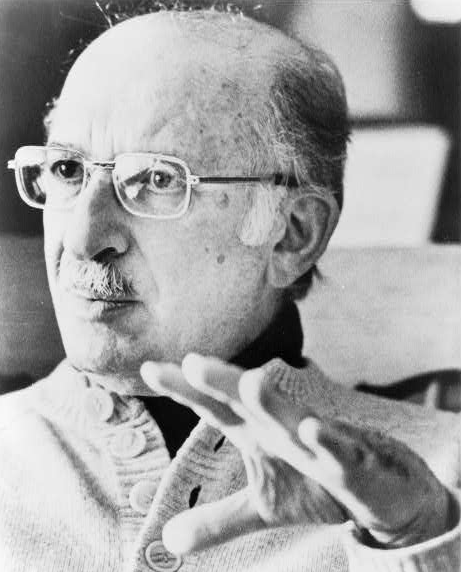
Recently, I read an article about one of my all time favorite and most inspiring writers - Bernard Malamud. The article claimed that Malamud was legendary for his incredible meticulousness when editing his work. But meticulousness was just one characteristic of his writing habits. He was most notorious for his drafts, edits of his drafts, and then even more edits. Before embarking on the editing process, it wasn't that unusual for Malamud to write as many as fifty drafts of any given story.
Clearly, by the time Malamud determined, at last, that the story with which he'd been consumed was really done, i.e., "ready for prime time" but not to be confused with finished, he knew every nuance of what was in the story.
Malamud began each of his beloved stories as a vague concept. His hope was to write "story" as a vehicle with which to illustrate precise, deep yet common emotions. But only through successive drafts was it possible for his intuition to dominate. Malamud's intuition provided accurate material, the accuracy of which grew continuously as a result of his continuous scrutiny and persistent revisions.
Literary art is neither entirely conscious nor unconscious; rather, it's an interplay between two attitudes typical of the process top writers employ. Drafting a story necessitates movement from inception to completion but simultaneously is a move from lesser to greater consciousness in both content and technique.
Much Like musicians and artists, writers practice, learn, and over-learn techniques of their art so that once inculcated, they can be performed with exactness, ease, and proficiency all fed by inspiration.
For those of us who've devoted so much of ourselves to writing, the fantasy that creativity pours spontaneously from the writer entices and thrills us. But reality prevails! Writing - good writing, is a complex process. It seems as though we experience the pleasure of spontaneity and freedom the most during our drafting phases.
Once we put our drafts on the road to becoming a finished work - the phase where drafts begin to transform into eloquent and excellent writing, then our greater focus is upon pleasing potential readers. Writing multiple drafts temporarily ignores readers' needs and pleasures. Instead, if we can extend the writing process a bit, then we also extend the uninhibited and self-indulgent nature of writing but we also extend the stage of most gratifying creativity.
Those not familiar with Bernard Malamud, might be interested to know that he was not regarded as especially prolific but was, and still is, regarded as an outstanding story teller and writer. My personal favorites are The Natural (1952) and The Assistant (1957) but below is a list of Melamud's other works.
The Magic Barrel (1958)
A New Life (1961)
Idiots First (1963)
The Fixer (1966)
Pictures of Fidelman: An Exhibition (1969)
The Tenants (1971)
Rembrandt's Hat (1973)
Dubin's Lives (1979)
God's Grace (1982)
The Stories of Bernard Malamud (1984)
The People and Uncollected Stories (1989)
Recently, I read an article about one of my all time favorite and most inspiring writers - Bernard Malamud. The article claimed that Malamud was legendary for his incredible meticulousness when editing his work. But meticulousness was just one characteristic of his writing habits. He was most notorious for his drafts, edits of his drafts, and then even more edits. Before embarking on the editing process, it wasn't that unusual for Malamud to write as many as fifty drafts of any given story.
Clearly, by the time Malamud determined, at last, that the story with which he'd been consumed was really done, i.e., "ready for prime time" but not to be confused with finished, he knew every nuance of what was in the story.
Malamud began each of his beloved stories as a vague concept. His hope was to write "story" as a vehicle with which to illustrate precise, deep yet common emotions. But only through successive drafts was it possible for his intuition to dominate. Malamud's intuition provided accurate material, the accuracy of which grew continuously as a result of his continuous scrutiny and persistent revisions.
Literary art is neither entirely conscious nor unconscious; rather, it's an interplay between two attitudes typical of the process top writers employ. Drafting a story necessitates movement from inception to completion but simultaneously is a move from lesser to greater consciousness in both content and technique.
Much Like musicians and artists, writers practice, learn, and over-learn techniques of their art so that once inculcated, they can be performed with exactness, ease, and proficiency all fed by inspiration.
For those of us who've devoted so much of ourselves to writing, the fantasy that creativity pours spontaneously from the writer entices and thrills us. But reality prevails! Writing - good writing, is a complex process. It seems as though we experience the pleasure of spontaneity and freedom the most during our drafting phases.
Once we put our drafts on the road to becoming a finished work - the phase where drafts begin to transform into eloquent and excellent writing, then our greater focus is upon pleasing potential readers. Writing multiple drafts temporarily ignores readers' needs and pleasures. Instead, if we can extend the writing process a bit, then we also extend the uninhibited and self-indulgent nature of writing but we also extend the stage of most gratifying creativity.
Those not familiar with Bernard Malamud, might be interested to know that he was not regarded as especially prolific but was, and still is, regarded as an outstanding story teller and writer. My personal favorites are The Natural (1952) and The Assistant (1957) but below is a list of Melamud's other works.
The Magic Barrel (1958)
A New Life (1961)
Idiots First (1963)
The Fixer (1966)
Pictures of Fidelman: An Exhibition (1969)
The Tenants (1971)
Rembrandt's Hat (1973)
Dubin's Lives (1979)
God's Grace (1982)
The Stories of Bernard Malamud (1984)
The People and Uncollected Stories (1989)
Subscribe to:
Posts (Atom)